Most HR leaders have sat in a room where two department heads are describing, in carefully measured language, the same problem from opposite directions. One says the other team is duplicating work. The other says the first team is encroaching on their assigned task. Both are right. Neither is entirely wrong. And the longer the conversation goes without structural resolution, the more expensive it becomes for everyone in the organisation who is not in that room.
Inter-organisational turf wars are as old as organisations themselves. But the conditions of the current business environment, including the hiring freezes, AI adoption and compressed resources, have made them more frequent, intense, and damaging than they were a few years ago.
Many leaders widely misunderstand HR's role in this dynamic. They believe that these inter-team disputes are a leadership problem, to be solved by the managers of the respective teams. This is a very narrow view, because if these turf wars are not resolved and escalate instead, unresolved turf wars lead to significant financial and reputational damage for the organisation.
This blog examines what inter-organisational conflict actually looks like, why it escalates the way it does, and what HR must do to intervene before the damage becomes irreversible.
What does a turf war look like from HR’s perspective?
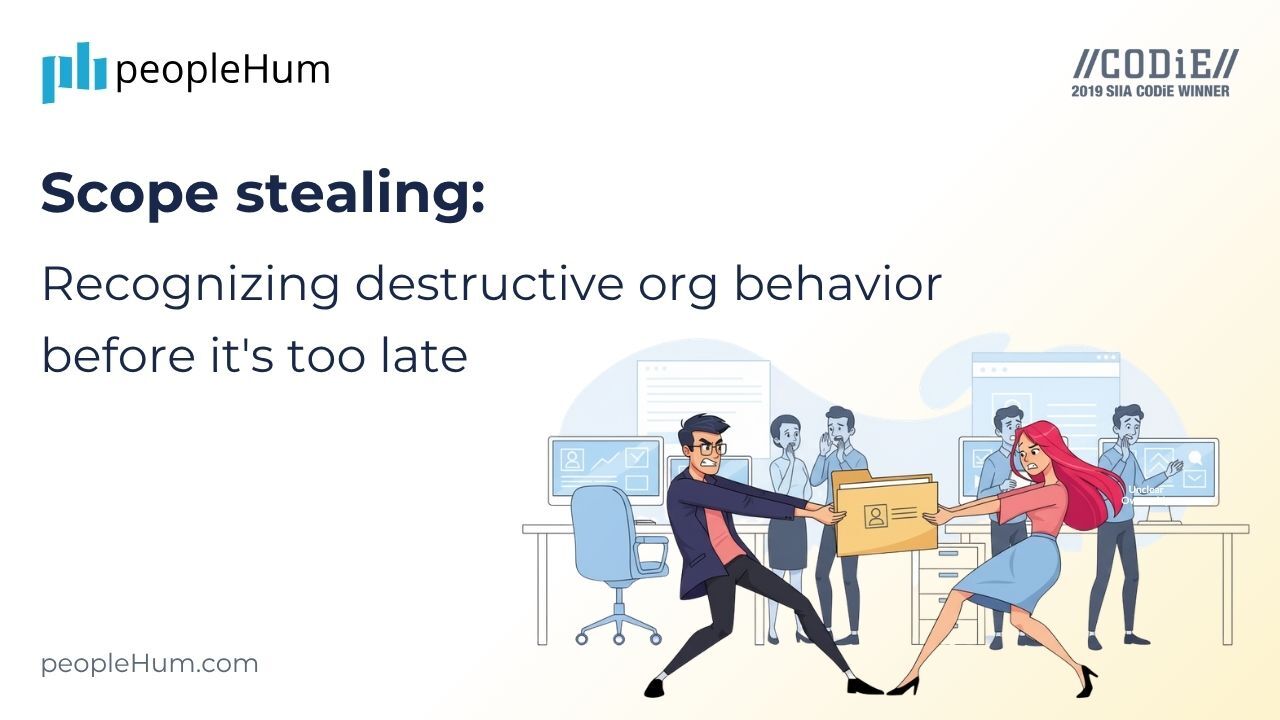
When a department head takes the lead on initiatives that fall within the responsibilities of another department, or when one team declines to share relevant data with another team, it often marks the beginning of a turf war.
This means that two or more teams in the organisation perceive each other as competitors for resources, recognition or relevance. This scenario typically arises during slow growth or periods of AI adoption, when organisations have frozen new hiring and investment in new tools is limited.
The defensive playbook: What teams do when they feel threatened
Understanding why and how teams defend their ‘territory’ is essential for HR professionals who want to intervene before the situation worsens. The defensive tactics that emerge in turf conflicts follow recognisable patterns, and each leaves a distinct mark on the organisation's culture.
- Making the ‘territory’ look unattractive: One of the most common defensive tactics is the deliberate amplification of a team's maintenance burden. A team that feels its scope is under threat begins emphasising, in senior conversations, the complexity of its work. The implicit message is: this team is harder to absorb than it looks.
- Overreacting visibly to indicate future resistance: When a team responds to a relatively minor issue with a disproportionate escalation, this reaction is not about the incident itself. It is a signal to the encroaching team and to senior leadership that this ‘territory’ will be contested. The overreaction is a deterrent, designed to raise the anticipated cost of future incursions high enough that they are not attempted. The problem is that it damages relationships and draws senior leadership into conflicts that should have been resolved at a lower level.
- The value story as offence: The most sophisticated and constructive response to a ‘territorial threat’ is the cultivation of a compelling, clearly articulated account of what the team uniquely delivers and why that value cannot be easily replicated or absorbed by another team. Teams that invest in their value story and communicate it proactively to senior leadership are significantly harder to encroach on than teams that wait until the threat arrives to begin making their case.
The cost of no intervention
HR leaders who do not take turf wars seriously, assuming that the relevant leaders will eventually work it out, are misreading the cost to the organisation.
- Execution cost: Most organisational work requires cross-functional collaboration. Naturally, teams that are engaged in territorial conflict do not collaborate efficiently. They share information selectively, protect their resources, and route decisions through escalation paths that bypass the direct working relationship. Every initiative that requires cooperation between two teams in conflict takes longer, produces lower quality output, and consumes more senior leadership attention than it should.
- Talent cost: The employees who are most damaged by inter-organisational conflict are the individual contributors and mid-level professionals. High-performing employees, who have the most options, lose patience with this environment fastest and leave. The teams that remain are the ones most willing to tolerate the dysfunction.
- Trust cost: Organisations run on the assumption that teams are working toward the same goal. When turf conflicts become visible, that assumption becomes harder to sustain. Employees begin to question whether the leadership team is aligned, whether the strategy is coherent, and whether the organisation's stated values around collaboration and shared purpose are genuinely held.
HR as structural architect: What genuine mediation requires
Genuine mediation of inter-organisational turf wars requires HR to operate at a level of structural intervention that most functions are not currently positioned to deliver. Here is what that actually involves.
- Map the ownership landscape before conflicts emerge: Most turf wars are predictable. They often start within grey zones or domains with ambiguous ownership. HR teams should conduct regular ownership mapping exercises, particularly when the organisational structure changes or when new strategic priorities create work similarities between existing teams.
- Redesign the incentive structure: Turf wars are, at their core, a response to an incentive environment in which teams are rewarded for their individual performance and visibility without adequate weight given to their contribution to organisational outcomes. HR teams that work with senior leadership to redesign performance frameworks so that cross-functional collaboration, boundary respect, and shared outcome delivery are explicitly measured and rewarded change the calculus that produces territorial behaviour.
- Intervention at senior level: Turf wars persist, in part, because senior leaders allow them to. A conflict between two department heads that has been visible for months without resolution is a signal that the leadership layer above them has not made the structural decision that would resolve it. HR must be willing to flag this directly with the relevant senior leaders.
Turf wars are a structural problem that HR is uniquely positioned to solve. When HR moves beyond its traditional role as a conflict mediator and operates instead as an architect of clear ownership, aligned incentives, and proactive leadership engagement, territorial conflict loses the conditions it needs to thrive. The organisations that will navigate the pressures of resource constraints and rapid transformation most effectively are not those where conflict never arises, but those where HR has built the systems to catch it early, address it structurally, and redirect competitive energy toward shared outcomes rather than internal rivalry.
Key Takeaways
- Inter-organisational turf wars are structural responses to resource scarcity, ambiguous ownership, and incentive structures that reward individual team performance over shared organisational outcomes.
- Territorial behaviour follows recognisable patterns: amplifying a team's complexity to make it harder to absorb, overreacting to minor incidents as a deterrent, and building a proactive value story to make the team's contribution harder to challenge. HR professionals who can identify these tactics early are better positioned to intervene before they become entrenched.
- The cost of no intervention compounds quickly. Cross-functional execution slows, high-performing employees leave first, and organisational trust erodes. By the time the damage shows up in attrition or performance data, it is already significant.
- Most turf wars are predictable. They start in grey zones with ambiguous ownership. HR must conduct regular ownership mapping exercises, particularly when the organisational structure changes or when new strategic priorities create overlap between existing teams.
- Redesign the incentive structure. When teams are rewarded purely for individual performance and visibility, territorial behaviour is the rational response. HR must work with senior leadership to explicitly measure and reward cross-functional collaboration and shared outcome delivery.
- HR must be willing to escalate unresolved turf wars to senior leadership and name them as an organisational risk. A conflict that has persisted for months without resolution is a signal that a structural decision has not been made. Continuing until that decision is reached is not overreach. It is exactly what the function exists to do.
See our award-winning HR Software in action

Book a demo
Schedule a demo





.jpg)


.png)
.png)


