
workplace
What does Apple TV's 'Severance' get right about the modern workplace?

Team peopleHum
April 20, 2026

5
mins

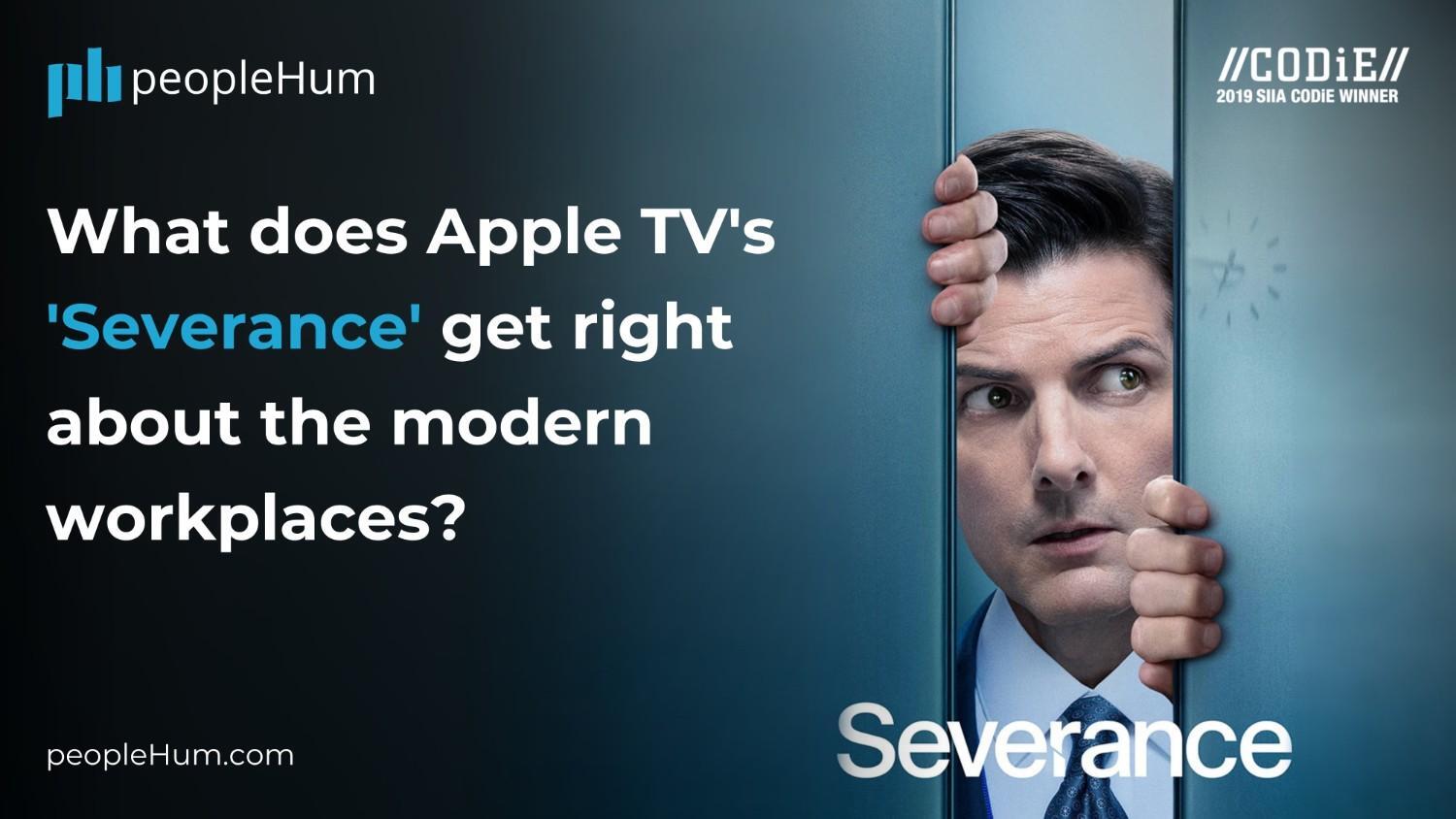
There is very little similarity between HR and science fiction. None, if you ask most HR leaders. But Apple TV’s critically acclaimed show, Severance, is a rare piece of fiction that unites these two seemingly different worlds. This show explores a dystopian future when an organisation decides that the most efficient version of an employee is one who exists only for work, remembers nothing outside it, and has no life that hinders task completion.
The premise of the show follows employees at the fictional Lumon Industries, as they undergo a surgical procedure called "severance" that splits their consciousness into two completely separate identities. Their "innie", the work-self, exists only inside the office, with no memory of the outside world. Their "outie", the external self, goes home at the end of the day with no memory of anything that happened at work. So, perfect separation and no distraction.
While it is slightly uncomfortable to imagine such a scenario in reality, the logic behind this is not totally far-fetched. Especially for HR leaders. It is an exaggeration of an ideal setting of any organisation: the desire for total employee availability, the discomfort with the full complexity of the human being who shows up to work, and the architecture of workplaces that treat personal life as a distraction from professional performance.
Before you start wondering, no, this is not a TV show review. This is an analysis of what Severance gets right about the work-life balance, where it shows faults in organisations’ desired ideal scenarios, and what insights HR teams can take from this for their own practice.
Severance is a perfect example of what would happen if a permanent wall were built between an employee’s work-life and personal life. The ‘innies’ working on the severed floors of Lumon industries have no personal identity at all. Down there, they are only recognised by the team they belong to, such as Macrodata Refinement (MDR), Optics and Design (O&D), wellness, and similar department designations.
The show, here, acts as a light reflection of something that already exists in many organisations. We often hear senior leadership say things like “we need people who are truly passionate" or "we expect you to give 100%." So, the expectation from the employees is that, regardless of what is happening in their personal lives, they must completely forget about it while totally committing themselves to their work, like an “innie”.
And it is the HR teams that have to deal with the consequences of the identity trap. Employees who have adopted their professional role as their complete identity are often acutely affected by redundancy, restructuring, and performance management. They are also the employees most at risk of burnout, and are most likely to stay in organisations that are not serving them well.
For HR, the identity trap is not just a well-being concern, but also an organisational risk. The employee whose entire identity is their professional role is the employee most resistant to the role changes, skill transitions, and career pivots that the pace of organisational change now regularly demands.
In Lumon Industries, the “innies” are rewarded for good performance with some absurdly hilarious prizes, such as a small toy and access to music and dance sessions. These rewards are meaningless in any objective sense as they have no financial value, no development value, and no relationship to what the employees actually need or want. They are, however, delivered with institutional ceremony and taken with apparent seriousness by both the organisation and, consequently, by the employees.
The satire works because the underlying dynamic is relatable to most employees. Replace the waffle party and the music session with a mandatory fun afternoon and a single-use voucher tied to a quarterly bonus cycle, and you have a recognition structure that does not produce any relevant outcomes.
Research by Deloitte found that organisations with highly effective recognition programmes have significantly lower turnover rates compared to those with poor or absent recognition.
What Lumon's recognition system illustrates is a recognition system that has lost its connection to the human being on the receiving end. The “waffle parties” are designed to be a sign that the organisation acknowledges employee performance, at the minimum possible cost, instead of making them feel genuinely valued.
Severance is fiction. Lumon Industries does not exist. No employee has undergone a consciousness-splitting procedure. And yet, the show uncomfortably resonates with many HR professionals, despite them having never worked anywhere like Lumon, but who know, immediately, what it is describing.
What it describes is the distance, in many organisations, between the employer's official relationship with its employees and the actual relationship those employees are living. The official relationship is partnership, investment, care, and shared purpose. The actual relationship, evidenced in the reward structures, the management practices, the working hour expectations, and the recognition systems, is sometimes something considerably more instrumental.
HR professionals are the function best positioned to see this gap and to address it because they have the data, the access, and the mandate to understand what the actual employment experience is producing, and to make the case for the structural changes that would close the gap between what the organisation says it values and what it actually rewards.
Severance does not tell HR professionals anything they do not already know. But it holds up a mirror that is angled differently from the one we usually look into, and the reflection it shows is worth looking at carefully.
Severance may be science fiction, but its greatest achievement is making the familiar feel strange. When you watch Lumon's "innies" receive waffle parties as rewards, or surrender their entire identity to a job title, the discomfort you feel is recognition of the dynamics that exist, in subtler forms, in real workplaces every day. Watching the show through an HR lens is an exercise in productive discomfort, one that prompts the kind of honest reflection that internal reports and engagement surveys rarely manage to showcase.
So, consider this a genuine recommendation: watch Severance, but watch it critically. Watch it and ask whether your organisation's recognition programmes are truly connected to what employees value, or simply performing the appearance of appreciation. Ask whether your culture is rewarding employees who surrender their full identity to their role, and what that costs them, and you, in the long run. The best HR strategies are born from honest questions, and few pieces of culture right now are asking them as sharply as this show.


HR insights delivered to your inbox.
Sign up to our newsletter and get expert tips on the latest trends, tactics, and thought leadership on all things HR.


.png)
.avif)