



Artificial Intelligence
Musk vs. Altman: The corporate feud HR leaders can't afford to ignore

Team peopleHum
May 4, 2026

6
mins

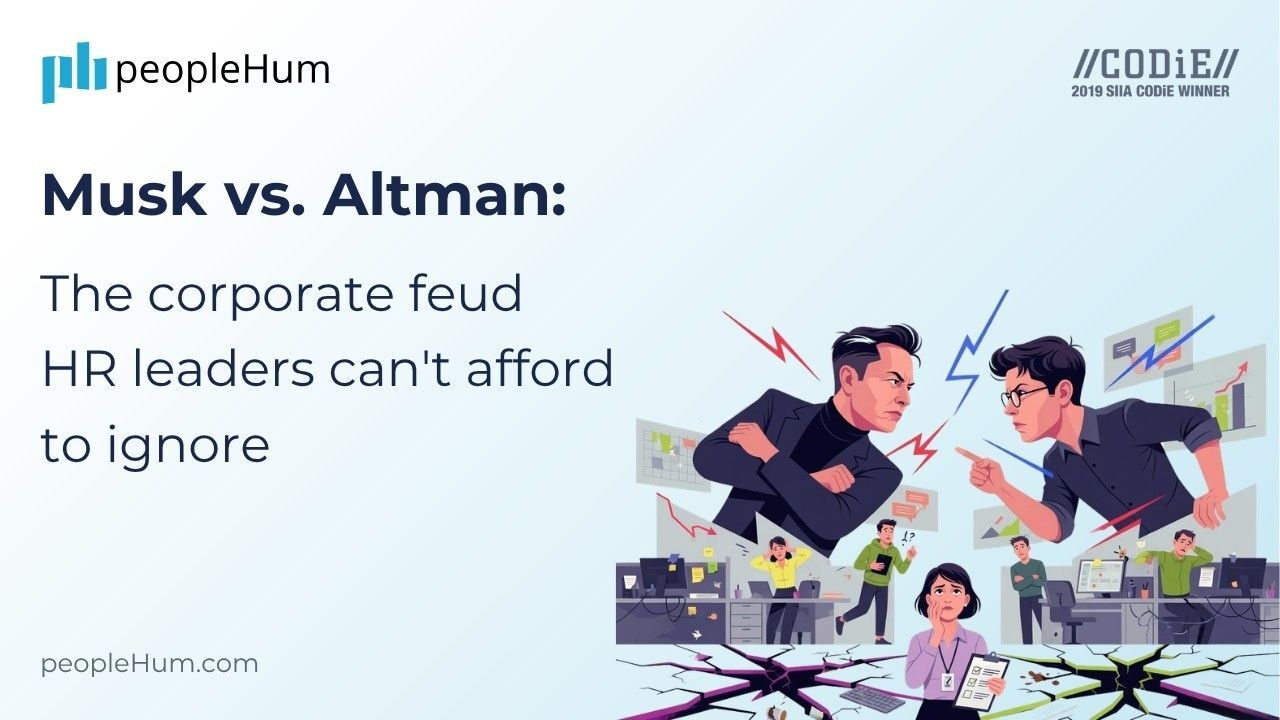
Two men co-founded a company with the mission of ensuring that Artificial Intelligence serves all of humanity.
But now, one of them is suing the other for allegedly destroying everything they built together.
Elon Musk and Sam Altman started OpenAI in 2015 as a non-profit. The mission was clear: develop artificial general intelligence in a way that benefits all of humanity instead of a selected few. They were, by most accounts, friendly collaborators, with Altman even calling Musk 'his hero.’
That partnership is now the subject of a federal trial in California.
Musk is accusing Altman of deceiving him out of millions of dollars and abandoning the non-profit mission they founded together. He wants his billions returned, and Altman removed from OpenAI. Altman and OpenAI, on the other hand, say Musk is motivated by jealousy, regret, and a desire to derail a competitor after walking away from the company in 2018 and launching his own AI venture, xAI.
A jury will now help decide who is right.
For most people, this is a compelling tech drama. But for HR leaders, this is something more than a spectacle. It is a signal. And the question it raises is one that every HR team working with AI tools right now needs to answer clearly: when the people who built these technologies cannot agree on what they were built for, what does that mean for the organisations that have automated their processes on them?
We will investigate this question in this blog.
To understand what is at stake, it helps to understand how Elon Musk and Sam Altman ended up at a crossroads.
The two men were reportedly introduced by a Silicon Valley investor in 2012. Altman was in his twenties, fourteen years younger than Musk, and already running Y Combinator, one of the most influential tech incubators in the world. That is when he pitched the idea of OpenAI to Musk. The pitch centred on responsible AI development, and Musk said yes, bringing in significant funding, and the organisation was launched in 2015.
By 2017, OpenAI had decided that the non-profit structure was insufficient to fund the kind of research required to stay competitive. The organisation moved toward a for-profit model. Musk wanted to be the CEO with full control, but the board rejected that. So, Musk left in 2018.
Then, in 2022, OpenAI released ChatGPT. And it took the entire tech world by storm. It reached 100 million monthly active users within a year and completely changed the technology landscape overnight. Elon Musk, meanwhile, launched xAI, which makes the chatbot Grok, a product that has lagged behind its competitors.
In 2024, this conflict escalated when Musk sued Altman and OpenAI, alleging that they had abandoned their founding mission and were instead focused on maximising profits for Microsoft, which had become a major investor.
OpenAI and Altman both deny this. Now, the trial will play out over a month in a federal courtroom. Whatever the verdict, the questions the case has raised are already out in the world. And HR teams are right to be paying attention.
For HR professionals, the Musk-Altman feud is already shaping the environment in which they make decisions about AI adoption.
The Musk-Altman dispute is not evidence that AI does not work. We have enough evidence to know that AI tools used by HR teams are used for payroll processing, onboarding automation, people analytics, and performance management work. The dispute is about governance and the commercial decisions made by the people running one specific company.
Allowing the Musk-Altman feud to dissuade HR teams from automation would be like abandoning Gmail because Sundar Pichai is involved in a dispute with another business owner on this platform.
What the dispute should prompt is more careful vendor selection. HR teams that choose AI platforms based primarily on marketing materials and pricing are not asking the right questions. The Musk-Altman dispute is a reminder that the values, governance structures, and commercial incentives of AI companies matter. HR should be asking those questions of every vendor it works with, regardless of who is suing whom.
This is where a platform like peopleHum stands apart. peopleHum built its AI-powered HR platform around a clear and consistent mission: to put people at the centre of every HR decision. Its governance is transparent, its data practices are designed to protect employee information, and its commercial model is aligned with the success of the HR teams it serves. In a landscape where the values of AI companies are suddenly very much in question, that clarity of purpose is not a small thing. It is exactly what HR teams should be looking for.
Despite the Musk-Altman dispute, there is a very good case to be made about why HR teams should adopt AI.
The Musk-Altman trial will produce a verdict. It will generate headlines. It will be analysed and debated in technology circles for years. But for HR leaders, the most important takeaway is not who wins the case.
The most important takeaway is this: the maturity of your organisation's approach to AI adoption must keep pace with the maturity of the technology itself.
Musk and Altman disagree about what OpenAI was built for. That disagreement reflects a broader reality about AI development: the technology is moving faster than the governance frameworks, the regulatory structures, and, in some cases, the values of the people building it. That is a real risk and HR teams must take it seriously.
But taking it seriously means building better vendor relationships, asking harder questions about data governance, and developing clearer internal policies about how AI tools are used and what decisions they are permitted to influence. It does not mean stepping back from a technology that is already reshaping how the best organisations manage their people.
Musk and Altman will continue their fight. HR teams have work to do.


HR insights delivered to your inbox.
Sign up to our newsletter and get expert tips on the latest trends, tactics, and thought leadership on all things HR.


.jpg)
%20(1).jpg)
.jpg)


